
Saying Touhou was a big part of some people’s lives is usually a massive understatement. Entire careers in different art fields launched off fans’ shared obsession with the franchise, from Toby Fox and his creation of Undertale to Shinobu Shinotsuki (Neichiru), who went from drawing Touhou’s Scarlet sisters to illustrating the globally acclaimed light novel series Youjo Senki. It’s a little-known but hugely significant cultural phenomenon that keeps shaping new artists to this day.
And the modern Windows era all started with this exact game: Embodiment of Scarlet Devil. Also known as TH06, being the sixth actual entry in the series, or EoSD, it just got a remake that brings this historic title not just to modern systems, but to a global audience as well. Now dubbed TH06NC, with the NC standing for New Classic, this version feels like a genuine labor of love. Spoiler: the result is near perfection.


Who Made It, and Why It Matters
The team behind it is Shanghai Alice Reprise, and it’s made up of fellow Touhou nerds: members of the doujin circle AQUA STYLE, plus developers from Twilight Frontier who’ve worked on both official Touhou games and fangames. That matters, because a remake handled by outsiders usually goes wrong in one of two ways. It either modernizes the game into something unrecognizable, or it preserves every flaw like a museum exhibit. New Classic does neither.
Instead you get an extremely faithful yet modernized recreation of the game that started it all (sorry, Mima), plus some really important quality-of-life improvements like showing your hurtbox when you’re focusing and adding an enemy indicator at the bottom edge of the screen. And even after all these years, it turns out Embodiment of Scarlet Devil still has a hell of a game underneath all that history.
What’s the Story About?
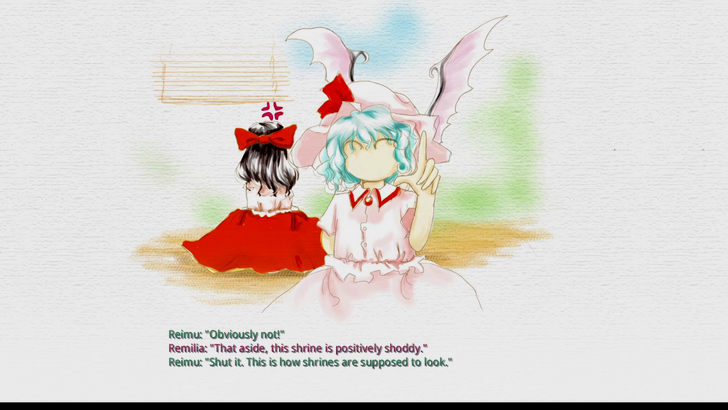
The whole thing centers on the Scarlet Mist Incident. Long story short: the vampire Remilia Scarlet tried to cover all of Gensokyo in a scarlet mist so she — who’s weak to sunlight — could go out whenever she wanted without a parasol. Because not having the sun is a problem for everyone else, our heroines Reimu Hakurei, the region’s shrine maiden, and her best friend Marisa Kirisame team up to find the culprit and ultimately beat them up.
…That’s basically the whole story. Or at least the important parts. Depending on which character you finish the game with you get different endings, but they either show one of the canon conclusions or — in the extreme case of beating it on Easy mode — the non-canon and inconclusive one. Someone caused an incident, Reimu and Marisa go looking for them, they meet and beat up everyone involved, and the day is saved. Extremely straightforward, almost to a fault.
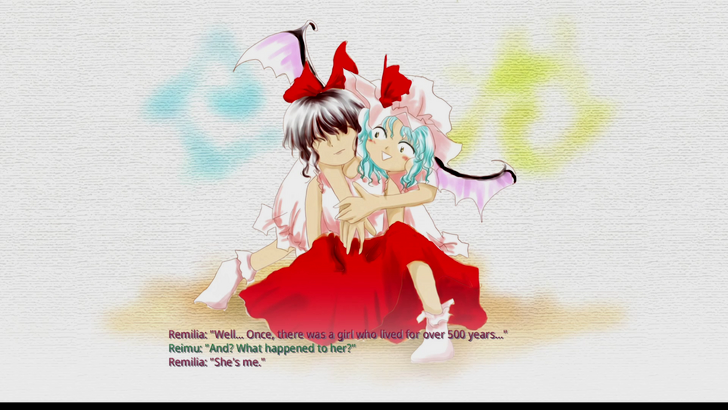
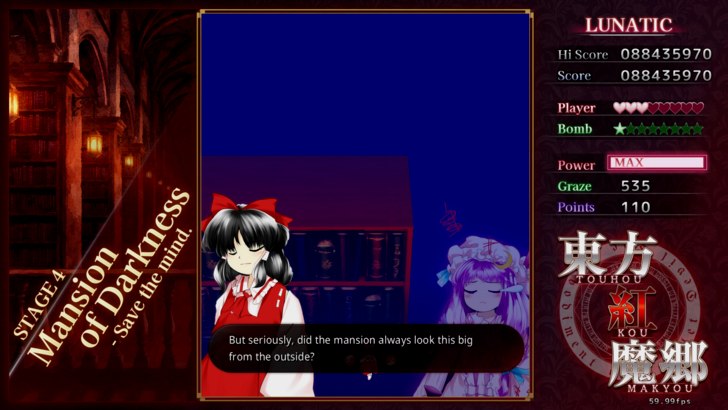
That doesn’t make it bad. Simplicity has its charms. But a lot of it — including lingering questions — is handled poorly in-game, or not at all. You have to read a magazine, Strange Creaturers of Outer World, just to learn the other and more important reason Remilia caused the incident: she was bored and wanted to test the newly established Spell Card Rules herself. This lack of depth would be a trend for a little while, at least until Mountain of Faith. The plot is mostly there to get Reimu and Marisa moving, and it works for that job. Which is ultimately the point: TH06NC faithfully preserves EoSD’s story, warts and all. The remake even embodies the early games’ lack of narrative substance.
How It Actually Plays
Bullet Hells Are Hard, but This Doesn’t Feel Unfair
Bullet hells are, in my not-so-humble opinion, in a tier of their own when it comes to difficulty. At the extreme end you’ve got CAVE’s shmups, like DoDonPachi SaiDaiOuJou, whose true final boss took the playerbase a full twelve years before someone beat it without using a single continue. Thankfully, Touhou isn’t part of that extreme. By almost every measure it’s easy enough to be called “baby’s first bullet hell,” while still being challenging enough to dunk on every newbie even on the lowest difficulty.
Wondering what a bullet hell even is? In plain terms, it’s a subgenre of shoot ’em ups where your main goal is to shoot down enemies while surviving until the end. Bullet hells crank up the number of projectiles until they can almost — or sometimes completely — fill the screen.
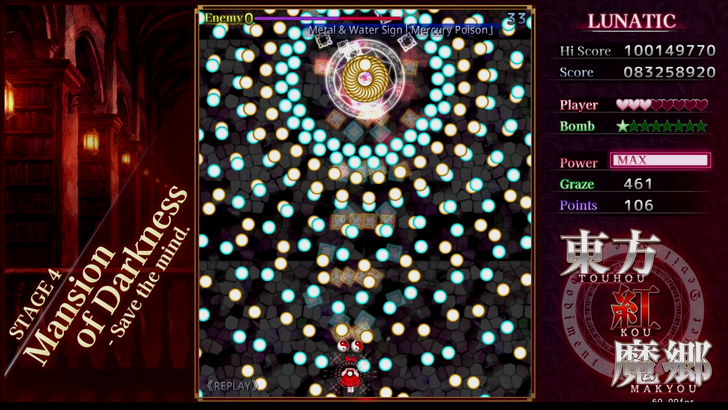
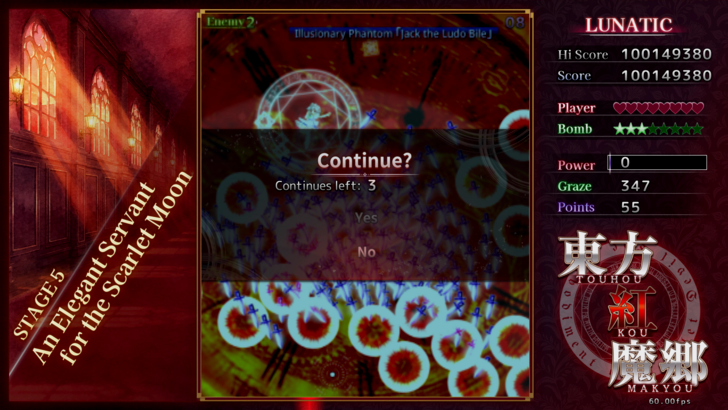
Now you might be wondering: how hard can a game where all you do is move around while shooting and dodging be? It’s super deceptive. The difficulty isn’t really in the immediate threats — it’s in how every stage and your own progression are set up. Shmups have become obscenely efficient at squeezing difficulty out of limited mechanics, and bullet hells amp that by an order of magnitude. In a traditional Touhou 1CC attempt, meaning a one credit clear or “no continues,” screwing up Stage 5 can mean the previous twenty or thirty minutes of solid play were just the setup for your eventual humiliation.
You aren’t just learning the boss’s patterns. You’re learning how to reach her with enough lives, bombs, Power, and concentration left to actually fight. In a way the bosses just identify each level; the entire level itself is the boss. That’s why people spend weeks or months working toward a single 1CC, even after individual sections become perfectly manageable.
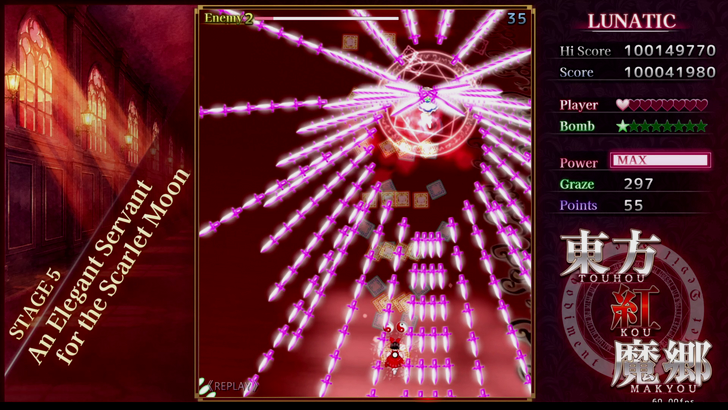
At a high level you’re learning routes, enemy destruction order, positioning, when to move, when to save a bomb, and when to manipulate or just ignore a pattern. That’s the part people who haven’t played serious shmups underestimate. But regardless of how hard it gets, EoSD never feels unfair. Every stage and boss runs on a framework that never changes: enemies show up at the same times and locations, and bosses use the same order of Spell Cards — that’s the name for each bullet pattern. Even the most impossible-looking patterns are consistent. It’s just asking you to learn what they mean. And no, I haven’t tried Extra yet. I’ll 1CC Lunatic first before I subject myself to Flandre’s games.
The Quality-of-Life Work Is the Whole Selling Point
Among the early Windows-era games, the original EoSD feels especially dated, even next to its immediate successor Perfect Cherry Blossom. That’s because it’s missing features that soon became series staples: the visible player hitbox and the enemy position indicator. New Classic carries over enough of them that it genuinely feels like playing a new game. Three additions stand out.
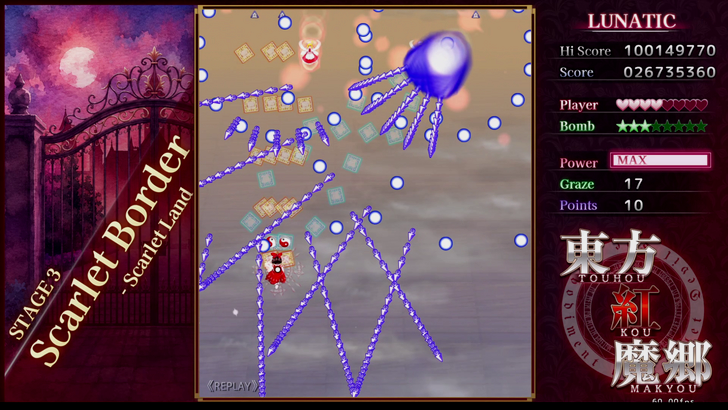
First is the visible hurtbox while you’re in Focus mode, originally introduced in Perfect Cherry Blossom. It shows you the exact spot where a bullet will make you evaporate. That completely changes the experience: instead of guessing where your tiny invisible hitbox is while weaving through dense curtains, you can make calculated moves and deliberately take risks based on info the game is handing you. It makes the game feel like it’s finally on your side instead of the enemy’s.
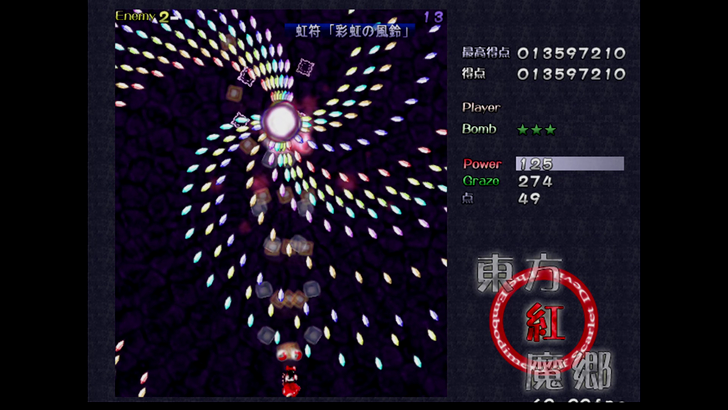
Second is the enemy indicator at the bottom of the screen. Most people naturally stay as far from the boss as possible, but when you’re staring at your own character so hard your eyes are practically bleeding, it gets surprisingly hard to track where the boss is. The indicator cuts the distance your eyes have to travel, which means you spend less time looking away from your own safety.
Third, there’s the Point of Collection — or rather, the later version of that feature adapted into EoSD. Cross an unmarked border near the top of the screen and you suck up all the Power and Point drops. The original TH06 had it, but only at max power. Now the mechanics match Mountain of Faith (TH10), so it’s always active no matter your condition. You gather far more Power and Points, which means more firepower and lives, more easily. It’s basically a difficulty lever built only from parts the modern mainline shooters already use, so the game keeps its identity.
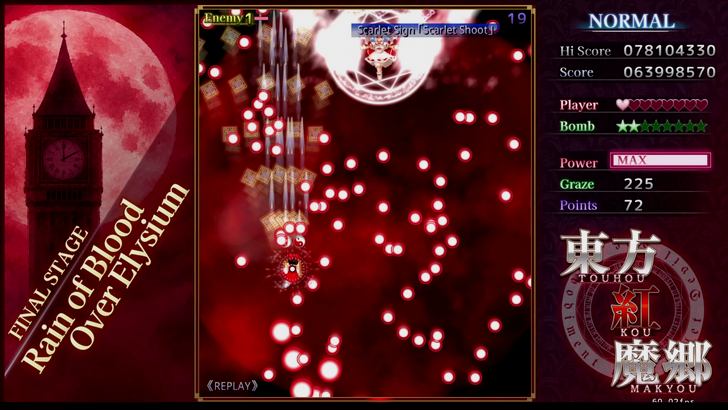
There are still additions that could’ve helped, like putting the boss HP as a circle around them instead of at the top of the screen. Looking up takes real time, which matters a lot when higher-difficulty Spell Card patterns leave you hair-breadth margins. But overall, the developers did an incredible job making this feel like a 2026 game, minus the odd gimmick newer shooters ship with, like TH20’s Incident Stones.
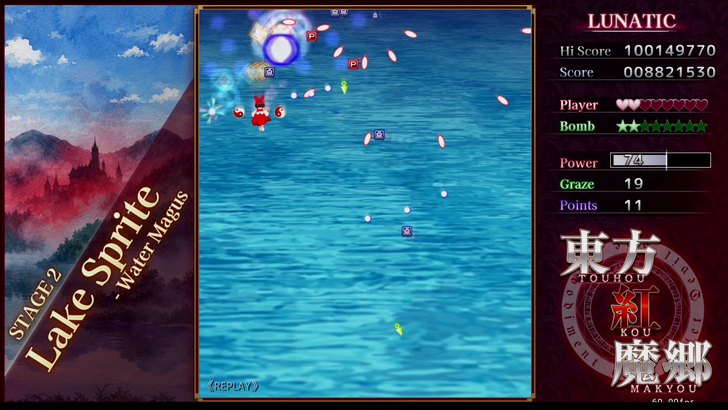
Every Character’s Identity Survives, Terrible Anatomy and All
Some of my favorite Touhou fan illustrations come from circles like AQUA STYLE (Touhou Danmaku Kagura), Nise-Eikoku Studio (Labyrinth of Touhou), and Mikan Douwa (Touhou Pocket Wars), alongside artists like Morino Hon and Zounose. So when I heard the remake’s illustrations would come from a collaboration between ZUN, AQUA STYLE, and Twilight Frontier (PatchCon: Defend the Library!), I worried ZUN’s signature artwork would get swapped for the other circles’ more polished versions.
That would’ve been bad. Part of the mainline games’ charm was ZUN’s weird anatomical quirks — Sukuna’s Double Dealing Character art basically has no arm attached to her left hand, Remilia has sausage fingers, and Meiling has elbow-less arms. Losing those would’ve felt like an affront.
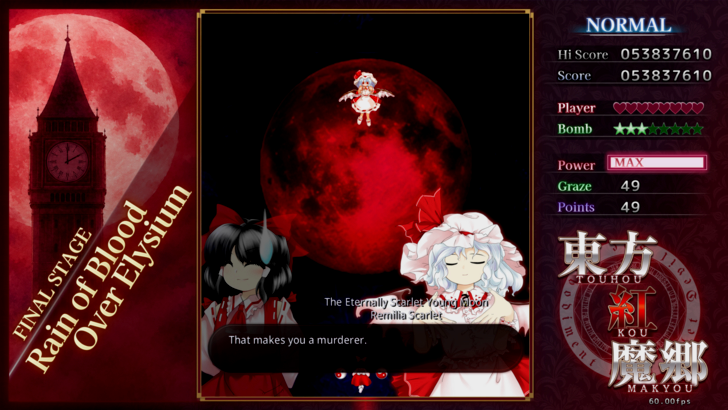
Thankfully, being the true Touhou enjoyers they are, the developers understood the assignment and recreated ZUN’s originals at modern resolutions. Now we can appreciate the first Windows-era cast in high definition, mangled joints and all. The character designs are part of the game’s identity and a piece of heritage that doesn’t need fixing. They’re awkward to look at, sure, but they communicate ZUN’s goals perfectly while being detailed enough to invite other artists to add their own spin.
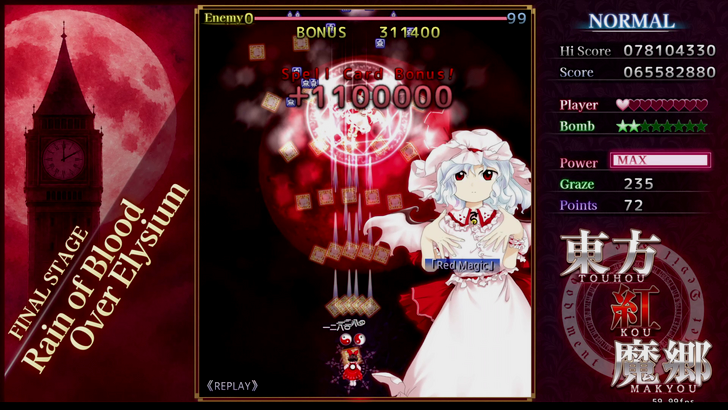
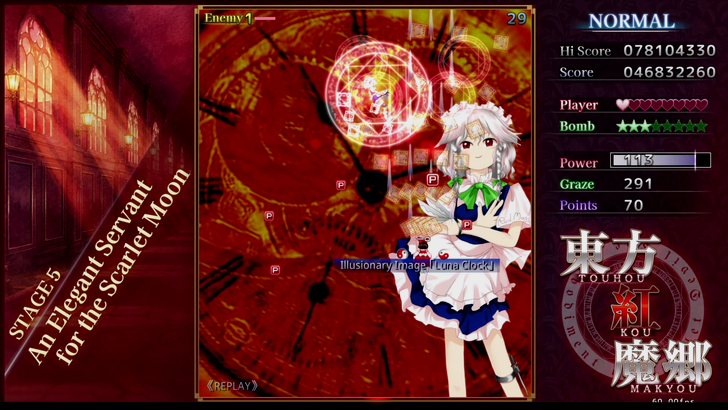
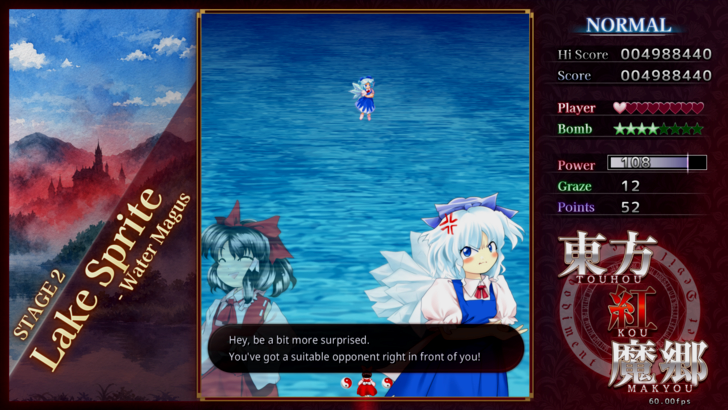
Take Sakuya. She’s a silver-haired maid holding knives, so it’s not exactly shocking that her attacks involve flooding the entire screen with them. I also appreciate that the bullet patterns — the Spell Cards, rather — stayed mostly untouched. That’s not just because it let me quickly 1CC the game on Normal, since I could still roughly remember patterns from over a decade ago, though that’s definitely part of it. It’s because the difficulty, the spectacle, and the patterns are an essential part of every character’s identity. Cirno’s Ice Sign [Icicle Fall] is still stupidly easy on Easy, as expected of the “Strongest” (idiot).
Is Touhou Embodiment of Scarlet Devil Worth It?
It’s such a steal, even Marisa wouldn’t think twice
The New Classic release is an incredibly faithful recreation of the game that kicked off the franchise’s glory era. Considering what it offers, the remake alone being sold for $17.99 is already an insanely good deal. On top of that you also get a true labor of love: a recreation of the heritage it came from, with full compatibility for modern systems — something ZUN himself couldn’t deliver, because he lost the code for the original. The developers really didn’t need to include that, and they did. That shows exactly how much they appreciate and adore the franchise.
Funnily enough, the price also technically means both games are sold for ⑨ dollars each. Combined with the fact that it released on the 9th day of the 9th month, this was a very strong day for us Touhou fans, indeed.
Quick answers
Voice acting? Just like the original, no. Extra Mode? “Just” 1CC Normal, Hard, or Lunatic difficulty.

The Bottom Line
Embodiment of Scarlet Devil is a piece of Touhou history that arguably still needed a bit of fixing, yet remains endearing to this day. New Classic modernizes the experience without compromising what made the original beloved, and including a Classic version on top makes this feel less like a remake and more like a love letter to the franchise’s heritage. Its story is still hilariously barebones and demands digging from anyone interested, but everything else is so faithful to the pleasure (and torture) that it’s hard to complain.
Touhou Koumakyou: New Classic - the Embodiment of Scarlet Devil delivers a great experience with a score of 88/100.