
Most war games want you on the front line, sprinting between cover and trading bullets. IRON NEST: Heavy Turret Simulator wants you sitting inside a four-legged steel giant, reading scout reports, scribbling coordinates on a clipboard, and cranking a bearing wheel until the numbers line up. You never see the battlefield directly. You just feed shells into a machine, wait, and listen for a dull thud in the distance. The more it asks of you, the better it gets, and by the end I couldn’t stop thinking about it.
IRON NEST: Heavy Turret Simulator is a dieselpunk artillery game focused on targeting, calculations, and firing shells at designated targets. Read our review to see what it did well, what it didn’t, and our overall impressions of the game.
What is IRON NEST: Heavy Turret Simulator?
It’s a first-person artillery simulation where you operate the Iron Nest, a massive war machine serving the nation of Castille during a conflict against anti-monarchist forces. From inside the machine you interpret reconnaissance reports, prepare firing solutions, and coordinate long-range artillery strikes while managing internal systems and battlefield support. You are not on the front lines yourself, and that’s the whole point.
The game is built around first-person artillery simulation and management, map-based firing solutions, dynamic mission challenges, heavy mechanical visuals, exceptional industrial sound design, and challenge missions with online leaderboards.


One Man War Machine
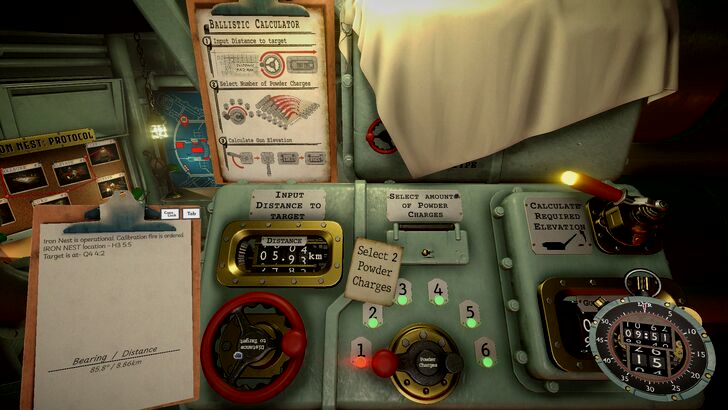
Military sims are hardly a niche curiosity anymore, but most of them zero in on the chaos of the battlefield itself. IRON NEST takes a totally different approach. It sticks you inside a massive dieselpunk artillery platform where the battle is experienced indirectly through scout reports, map coordinates, firing calculations, and the constant operation of an industrial war machine.
That perspective gives the game a real identity. The early missions care far less about reflexes and firefights, and far more about maintaining a firing workflow: jotting down coordinates on a clipboard, calculating bearings and elevation, prepping the guns, calling in reconnaissance support, and waiting for confirmation that a shell actually landed where you aimed. By keeping the battlefield at arm’s length, the game turns artillery operation into a process that’s as much about information management and machine handling as it is about blowing stuff up.
What becomes clear fast is that the strengths here come from how committed it is to that operator-focused view. The later missions don’t reinvent the core artillery systems, but they throw in new objectives and battlefield complications that keep reshaping how you use familiar tools. Add in the tactile machine operation, layered artillery procedures, and oppressive industrial atmosphere, and you get something that feels markedly different from your typical military shooter.
Good Soldiers Never Question Orders
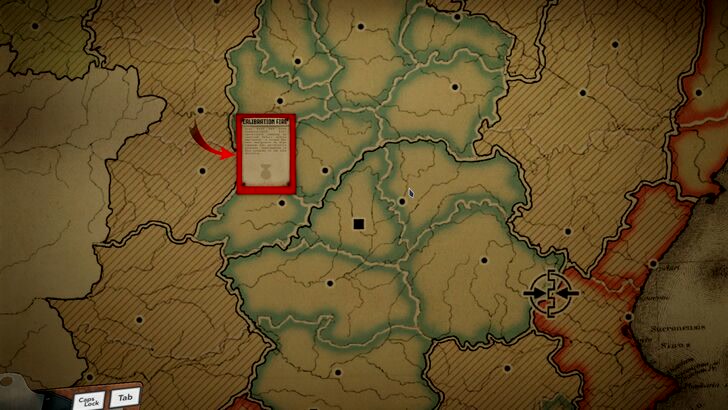
You play an operator serving Castille from inside the Iron Nest, a newly developed four-legged artillery war machine whose existence seems largely unknown to the public during the early missions. What starts as a routine calibration exercise gets reported by the press as a rebel bombing of a civilian area, and subsequent operations keep hinting that the official story behind the conflict doesn’t hold up.
The game gives you very little info about the operator beyond their role inside the machine. For most of the campaign there’s no clear explanation for why this character was chosen to pilot the Iron Nest, and no strong personal motivation driving things forward. A later exchange briefly drops the name Anton, seemingly identifying the protagonist, only for follow-up correspondence to reveal that Anton is actually the name of the Iron Nest’s main turret, inherited from the dreadnought Alfonso XIII where the weapon was originally mounted. That misdirection says a lot on its own: even when the game seems ready to humanize the operator, it pins the name to the machine instead of the person controlling it.
One of the most effective recurring threads comes through letters from a Castille soldier named Tomas. His first letter describes surviving an artillery strike after falling into one of the Iron Nest’s massive footprints while the rest of his squad was killed nearby, and the line “But God didn’t put that hole there. You did.” initially reads like it could be either condemnation or gratitude. As the letters continue, Tomas comes across less as someone who hates the Iron Nest and more as a young monarchist conscript trying to process the sheer scale of the war around him.
He writes about marching through abandoned villages, sketches the Iron Nest itself, and even describes nightmares about multiple copies of the machine. Those letters gradually shift the relationship from simple survivor testimony to something closer to fascination mixed with fear, giving the campaign one of its few genuinely human perspectives on the weapon you’re operating.
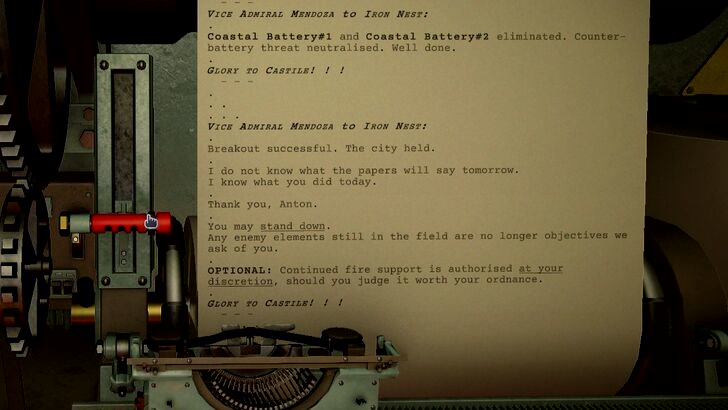
The most interesting choice is that it withholds meaningful agency for most of the campaign. The early missions strongly suggest the official version of events is BS, yet the operator is never given a chance to question, refuse, or even meaningfully react to those orders. You’re powerful enough to level entire city blocks, but you know shockingly little about the people giving the commands, the civilians affected, or even the protagonist you’re controlling.
Only the final mission lets you make a real decision about which shell gets fired into the city, and that late moment of choice hits harder precisely because the rest of the campaign trained you to follow procedures rather than shape events.
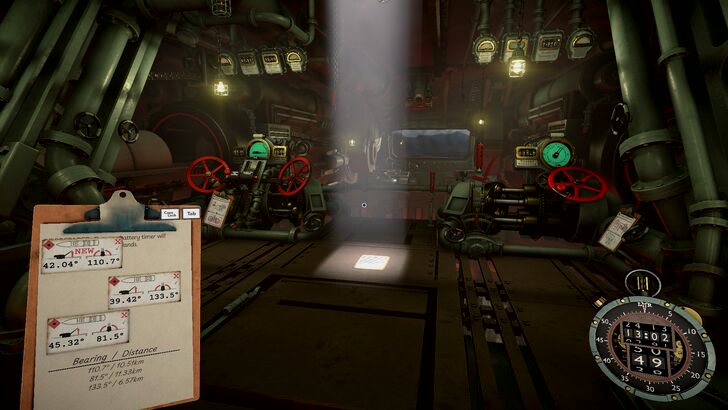
That tension is what gives the story its uneasy tone. The game rarely asks you to witness the battlefield directly, relying instead on maps, reconnaissance reports, printed photographs, and personal correspondence to communicate the results of each operation. Because destruction is experienced almost entirely through procedures, coordinates, and after-action info, it becomes surprisingly easy to think of targets as tasks to complete rather than people caught in the blast radius.
Tomas’ letters matter precisely because they interrupt that detachment. They don’t fully restore the human cost of the conflict, but they repeatedly remind you that every coordinate on the map belongs to a world inhabited by scared soldiers, abandoned civilians, and people trying to make sense of a war they only understand in fragments.
Gather Your Bearings and Take Aim
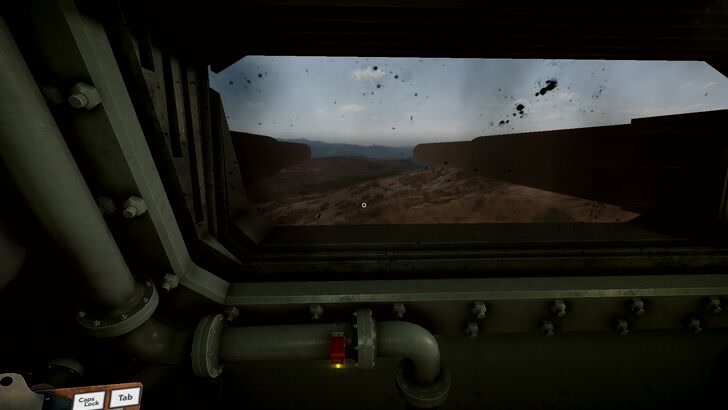
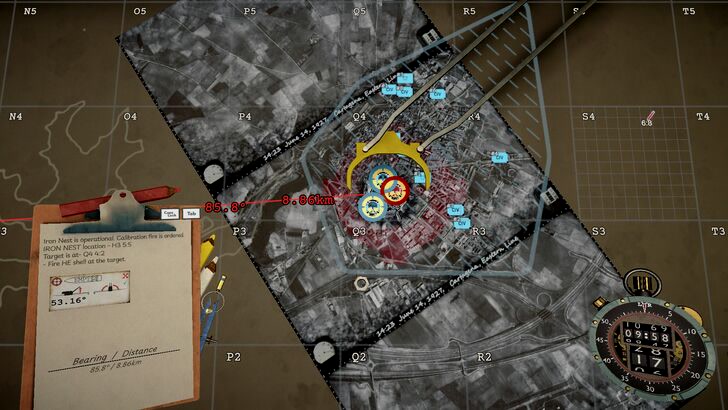
That sense of procedural distance becomes way more convincing once the artillery systems come into play. The game doesn’t play anything like a traditional shooter. You receive battlefield coordinates from scouts, plot firing solutions on a map, adjust elevation and bearings, prep the guns, and wait for reconnaissance reports to confirm whether the shot landed on target. You can’t act preemptively, and mistakes like underloading, overloading, or entering the wrong firing data have to be corrected through the machine’s own systems, so each successful strike feels earned rather than issued as a disposable attack command.
Orders and scouting updates arrive as text reports, and the clipboard becomes central to managing the Iron Nest’s increasingly complex workflow. Relevant lines get copied onto the board, removed when no longer needed, and completed calculations automatically generate notes with the bearing and elevation values for the planned shot. Once the second gun shows up, keeping multiple firing solutions, target coordinates, and correction notes visible at once becomes a lifesaver, letting you prep one gun while the other cycles through its firing sequence. Because the clipboard records what you calculated instead of solving the encounter for you, any mistake in the firing data still comes down to you, not the interface.
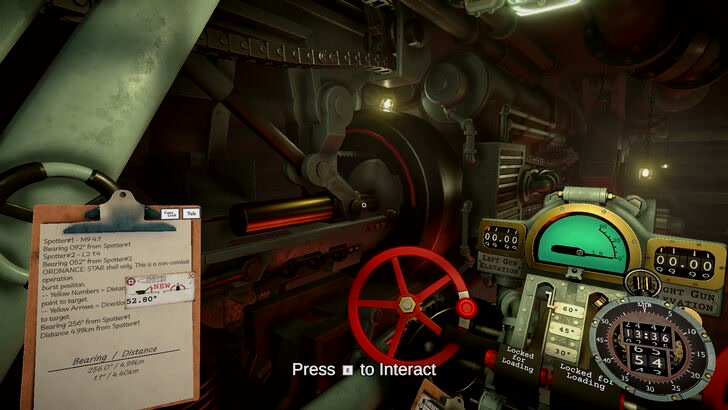
The physical interaction with the machine is what lifts the experience above simple map-based artillery management. Elevation and bearing adjustments run through big cranks that can be locked into continuous rotation with a lever. The mechanism has momentum, so it keeps spinning briefly after you return it to neutral, and trying to stop it manually can overload the system, forcing you to relieve pressure through nearby valves before you can keep going.
Little touches like that make the Iron Nest feel less like a menu-driven weapon platform and more like a temperamental piece of industrial machinery that demands respect. Because the machine can resist, drift, or punish careless input through overloads and pressure management, even routine adjustments require careful handling. A poorly corrected shot can waste valuable time, burn through limited ammunition, or even hit friendly forces.
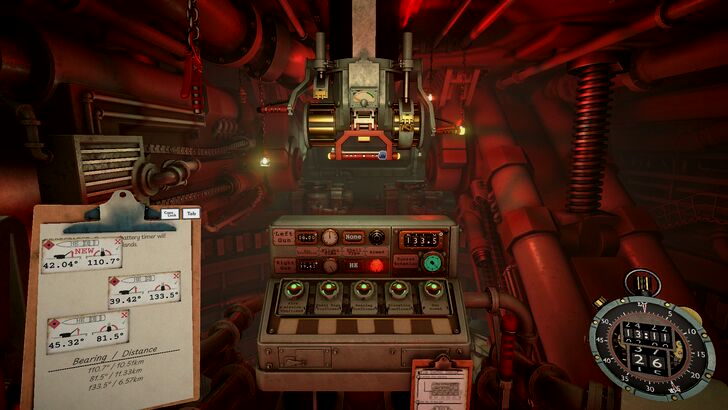
Firing the guns reinforces that same sense of weight: the hydraulics groan under strain, the whole screen shakes when a shell launches, and a brief ringing effect lingers afterward, giving each shot a tangible physical impact. The tension doesn’t end when you pull the trigger either. Targets are rarely visible directly, so there’s often a delay between firing and finding out whether the shell actually hit. That downtime becomes part of the workflow. While waiting for confirmation I was usually already prepping the next shell, reviewing incoming orders, or plotting the next firing solution instead of staring at the screen for a hit marker.
That uncertainty makes reconnaissance one of the most critical parts of the loop. STAR shells light up a large area for temporary observation, while scout planes reveal units along a chosen flight path and give a snapshot of enemy positions rather than continuous tracking. The info is useful, but it’s temporary. Later missions can reveal additional artillery emplacements or other threats after you’ve already acted on the original reconnaissance, forcing you to adjust firing solutions and target priorities as new intel arrives. The challenge isn’t just landing a shot, it’s deciding whether the info in front of you is reliable enough to commit another shell, another requisition card, or another chunk of time.
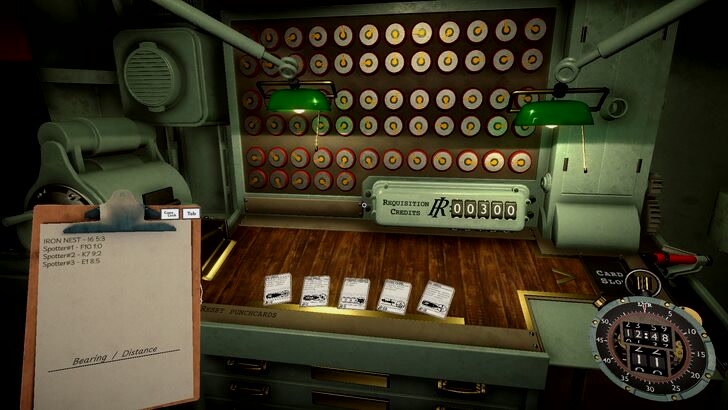
The campaign also does a solid job of broadening the machine’s responsibilities over time. Early missions focus on the core firing procedure, but later operations add tasks like manually starting the engine, coordinating battlefield support, and using requisition cards to call in ammunition, reconnaissance, or repositioning assistance. Not every mission uses every system, but their presence helps the Iron Nest feel less like a stationary artillery piece and more like a mobile war machine that demands constant oversight.
Mission design gets noticeably more demanding as you go. Later operations might take away access to the elevation calculator, limit reconnaissance support, introduce moving targets, or force the Iron Nest to operate under direct enemy threat while multiple objectives compete for your attention.
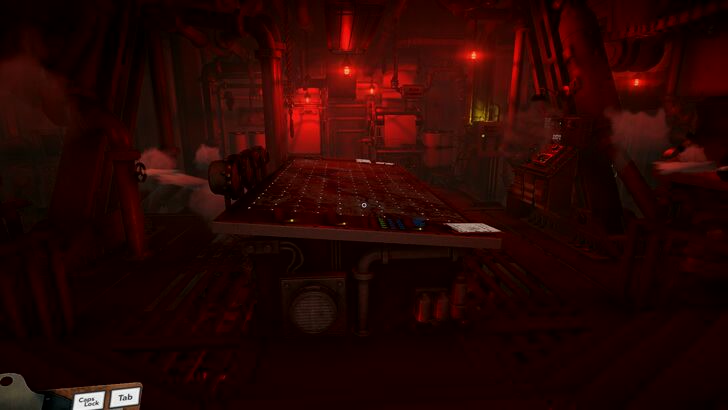
The real challenge comes from keeping all of those interconnected systems running at once, balancing firing solutions, reconnaissance, machine operation, and battlefield awareness under increasingly hostile conditions. What impressed me most is that the satisfaction rarely came from watching explosions. It came from keeping the Iron Nest operational while juggling all of those moving parts under pressure.
By the end of the campaign, the artillery procedures, reconnaissance requests, machine systems, and battlefield pressures no longer felt like separate mechanics stacked on top of each other. They felt like parts of a single workflow that demanded planning, attention, and constant adaptation. That increasing operational complexity is where IRON NEST’s gameplay is most successful.
The Beauty in the Certainty of Steel
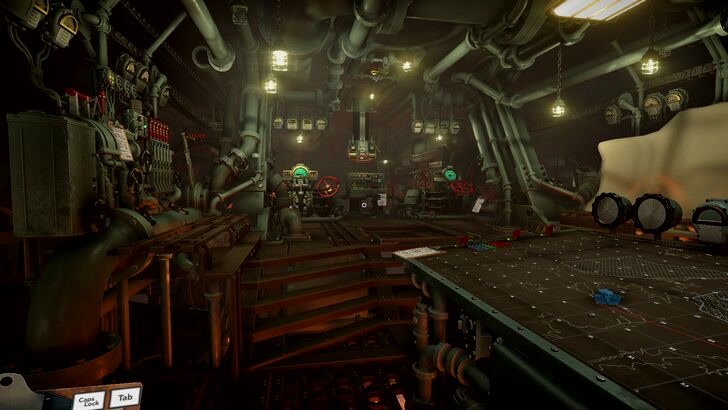
You don’t spend much time admiring sweeping landscapes here, since the game keeps you largely confined to the interior of the Iron Nest. Fortunately that interior carries the presentation on its own. The structure is unapologetically industrial, packed with enormous steel supports, exposed piping, heavy loading mechanisms, and constantly moving machinery. Even routine actions like spinning the bearing wheels or watching shells get fed into the cannons have a satisfying physical presence, and the visible recoil rippling through the machine when a shot fires reinforces that the Iron Nest is an immense industrial weapon rather than a static control room.
The audio is what really sells the illusion. Grinding gears, hissing pressurized pipes, groaning hydraulics, and the deep concussive boom of each shell combine into an unusually convincing mechanical soundscape. I often kept the Iron Nest’s record player running while working through firing solutions, both because the music itself was enjoyable and because it gave a welcome contrast to the constant industrial noise.
Even with the soundtrack playing, the machinery never fully fades into the background. Creaking steel, spinning mechanisms, and heavy hydraulic movements stay consistently audible, creating a constant industrial hum around every action. One detail stood out: the dull but clearly audible thump that arrives when a shell finally lands somewhere in the distance. It’s brief and understated compared to the violence it represents, and the game almost immediately returns to the steady rhythm of gears, pipes, and hydraulics. For a moment you hear the result of the shot. Then the Iron Nest drowns it out and demands your attention back.
From a technical standpoint the presentation was generally stable during my playthrough, and the interface is straightforward to navigate, which matters a lot for a game built around calculations, reports, and firing procedures. I did run into occasional minor stutters, and they stood out more than expected given that most of the game takes place within the relatively enclosed interior of the Iron Nest. The hitching wasn’t constant, but it was noticeable enough to occasionally draw attention away from an otherwise strong presentation.
Is IRON NEST: Heavy Turret Simulator Worth It?
A Shot Well Placed
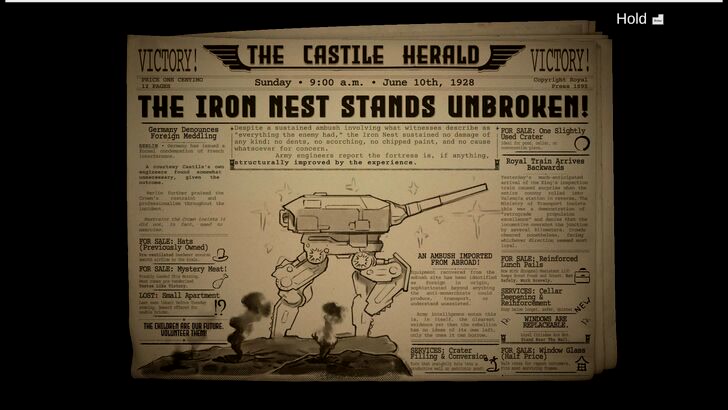
IRON NEST: Heavy Turret Simulator left a stronger impression on me than I expected from a game built almost entirely around operating a confined artillery platform. Its story stays intentionally distant, but the combination of tactile machine interaction, layered firing procedures, demanding mission design, and exceptional mechanical and sound design makes operating the Iron Nest consistently compelling from start to finish.
More importantly, it succeeds in making artillery feel less like a spectacular superweapon and more like a routine that has to be managed, maintained, and executed correctly under pressure. What stuck with me most was how quickly artillery strikes stopped feeling like dramatic battlefield events and started feeling like another procedure to complete: check the coordinates, correct the bearings, prep the next shell. If you enjoy methodical simulations, immersive mechanical interaction, and the challenge of managing a complex war machine, IRON NEST is an easy recommendation.


Interesting! ))
Final Verdict
IRON NEST: Heavy Turret Simulator delivers a excellent experience with a score of 90/100.